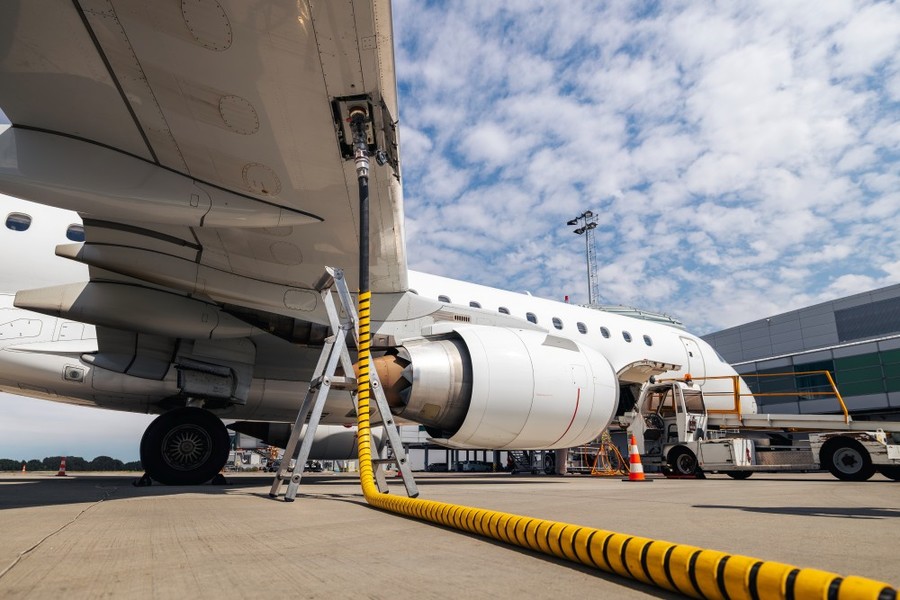
The decarbonization of aviation is one of the most complex challenges facing our industry. A key lever for achieving climate goals is the rapid scaling of sustainable aviation fuels (SAF) and the integration of hydrogen into the value chain. But what does practical implementation look like, which regulatory hurdles must be overcome, and what role does the Hamburg Metropolitan Region play in this global transformation process? In the following interview, Dr.-Ing. Anna Lisa Junge, SAF & H2 Infrastructure Focal Point Germany, provides deep insights into Airbus’ strategies, the technological synergies between eSAF and hydrogen, and the importance of strong industrial ecosystems for a climate-neutral future of aviation.
At Finkenwerder, Airbus is already using SAF. Is a sufficient quantity available for this?
At our Airbus site in Hamburg-Finkenwerder, we have already integrated sustainable aviation fuels (SAF) into our operational activities to reduce our Scope 1 and Scope 3 emissions. Scope 1 includes test and Beluga flights. Here, we are already using a 21% share of SAF and will increase this to 30% by 2030. As an example for the reduction of our Scope 3 emissions, I can mention our internal employee flights between Hamburg and Toulouse. Here too, 10% SAF is blended to lower the lifecycle CO2 emissions of our business travel. We have sufficient quantities available through a long-term supply agreement. This also reflects the global situation: in 2025, 1.9 million tonnes (Mt) of SAF were produced globally; enough to meet demand and to fulfill the ReFuelEU quota. Looking to the future, additional voluntary demand (i.e., SAF demand that goes beyond mandatory quotas) should contribute to increasing production capacities. Corporate commitments, particularly through the integration of SAF into business travel programs, are a crucial lever for unlocking this market potential. For this, we have agreements with airlines such as Air France-KLM, Lufthansa, Iberia, and easyJet for our business travel.
What can an OEM do to drive the development of SAF?
Airbus positions itself as a catalyst in the SAF ecosystem to promote the production and offtake of sustainable aviation fuel. In doing so, we rely on cross-industry partnerships, investments in SAF, and political and regulatory engagement. For SAF supply, we work closely with producers and project developers. As a concrete example, we recently announced the Rebound joint venture, consisting of Technip Energies, Airbus, Safran, and Tereos. With Rebound, a production capacity of 160,000 tonnes of Alcohol-to-Jet SAF per year is being developed at the port of Dunkirk in France, thereby strengthening European energy sovereignty. Furthermore, there are existing co-investment partnerships with Qantas, Cathay, and Air Canada. To further strengthen the demand side, we support the recognition of Book and Claim (B&C) as a chain of custody model. This mechanism allows customers to purchase SAF without being physically connected to a delivery facility. The transactions (issuance, holding, transfer, and retirement of emission reduction certificates) are tracked and validated via a registry. Regulatory authorities and CO2 accounting standards do not yet accept B&C, which limits its use and prevents airlines from using it to meet their mandatory or voluntary climate targets. Airbus collaborates with key stakeholders, including the European Commission, IATA, and various sustainability organizations (such as the Smart Freight Center, RSB, and ISCC). In addition, Airbus demonstrates the credibility and relevance of the solution through projects like the Airbus Book & Claim Demonstrator (ABCD), acting simultaneously on a reputational, voluntary, and political level.
How do eSAF and hydrogen complement each other in Airbus' long-term decarbonisation strategy?
It is important to distinguish between Airbus’ own decarbonisation strategy and the decarbonisation strategy of the aviation sector as a whole. The former includes all projects and initiatives that we are driving forward for our decarbonisation (Scope 1-3), including the decarbonisation of our sites. Scope 3 emissions, i.e., caused by our products in use, account for a large proportion of our carbon footprint. Here is the link to the decarbonisation strategy for aviation here. All SAF production pathways play an important role. Airbus acts as a catalyst to promote the global development of SAF production, regardless of the technological pathway. The importance of eSAF (Power-to-Liquid, PtL) will increase in the future, as the PtL quota within RefuelEU will rise successively starting in 2030. However, it is also clear that there is still a lack of final investment decisions for the production of PtL. For the production of PtL, hydrogen is used, which is then converted into syngas with the help of CO2. Furthermore, liquid hydrogen is also important as an energy carrier for our future hydrogen aircraft program. The aircraft will be powered by electric drive motors, each driven by a fuel cell system that converts hydrogen and oxygen into electrical energy. Thus, hydrogen is an important component for the decarbonisation of aviation, both for the production of eSAF and as a fuel for hydrogen-electric flight.
Currently, Airbus aircraft are permitted to fly with a maximum 50% SAF blend. What progress has been made towards achieving 100% compatibility with eSAF? What research is still needed here?
We must consider all SAF production pathways that are already certified or are being certified for 100% SAF compatibility, not just eSAF. There are two important axes that must be pursued simultaneously to scale SAF. First, we are actively supporting the short-term economic scaling of SAF production. The most critical short- to medium-term challenge is to support the value chain in balancing supply and demand so that the industry can utilize this existing 50% capacity. According to IATA, SAF production in 2025 accounted for only 0.6% of total jet fuel consumption. At current price levels, the SAF premium translated into an additional USD 3.6 billion in fuel costs for the industry in 2025.
Second Airbus contributes to SAF research on existing and new production pathways including continued testing of 100% SAF. Airbus actively supports industry-wide standardisation efforts at ASTM International to enable use of new production pathways, and up to 100% SAF in operations. Collaborative industry projects led by Airbus such as VOLCAN and ECLIF were essential to that roadmap. CRYSTAL and ECLIF-X are new projects that will further contribute to this research.
Focussing on Hamburg: How do you assess the potential of the Hamburg region as a testing ground or production site for synthetic fuels compared to other international locations?
As a significant logistics hub (similar to the situation with hydrogen), Hamburg can be a junction for the handling of SAF and its feedstocks. I am explicitly referring here again to all SAF production pathways. Recently, for example, Methanol-to-Jet (MtJ) was certified; a hub-and-spoke MtJ concept would be conceivable. As a production site, we will also have a significant production facility here in Hamburg with the Holborn plant, which will produce HVO and SAF. With regard to Germany, I think it makes sense to consider all feedstocks that we have available locally to check which ones are suitable for efficient SAF production, e.g., via Fischer-Tropsch, and to utilise this potential.
The costs for eSAF are currently significantly higher than those of conventional kerosene. In your view, what levers need to be pulled to establish a marketable price structure? What is your opinion on the Federal Government's planned instrument to support a dual auction system with €2 billion?
Especially for the production of eSAF, we are competing with our energy prices against countries that have lower costs for low-carbon electricity. While energy costs play a major role in eSAF production (as does the grid capacity to provide this energy), the cost of the CO2 source is also important. To lower the costs for eSAF, inexpensive electricity from renewable sources or green hydrogen, economies of scale, and financing costs - which can be lowered, for example, through risk-sharing in the offtake - are important. This is precisely where the Federal Government’s dual auction mechanism comes in, which we welcome.
What is your stance on projects like Giga PtX – do you see the development of eSAF for defence as promising for civil aviation?
Here, too, the focus should not be solely on eSAF. If military and civil fuel supply are considered in terms of synergies, then, on the one hand, guarantees can be provided through joint offtake mechanisms that can favour the final investment decision for SAF plants. On the other hand, SAF can make the military fuel supply more resilient. Thus, such a synergy can be a win-win for both civil and military aviation while simultaneously contributing to accelerating the transformation towards a larger share of SAF in air traffic.