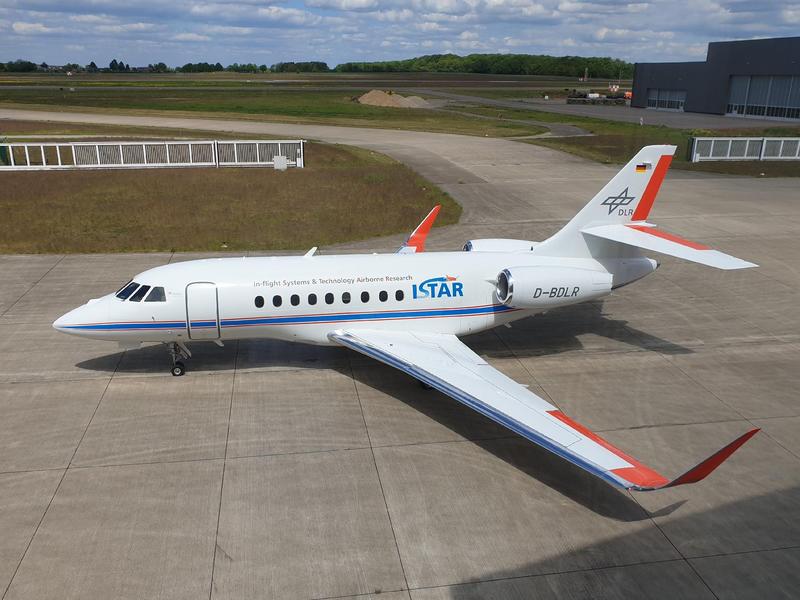
With 11 aircraft, the DLR operates the largest fleet of research aircraft in Europe. The latest addition – the Dassault Falcon 2000LX – has been in service since 31 January 2020 under the name ‘ISTAR – In-Flight Systems and Technologies Airborne Research’. With ISTAR, the DLR has a flight test platform that is being used to develop new technologies, simulate new aircraft and further advance the digitalisation of aviation. ISTAR was initially fitted out in Braunschweig with a basic measurement system for collating and providing a wide variety of flight data. Workstations for flight test engineers, who control experiments and monitor flight parameters on board, have also already been installed.
This presentation by the Hamburg Branch of the Royal Aeronautical Society begins by describing the phase from the initial idea to the roll-out on 20 February 2020 in Braunschweig. The middle section explains in detail the integration of the experimental intervention into the flight control system via the standard autopilot components. Finally, the first scientific ISTAR flight tests are briefly presented as examples.
Please note: This lecture is in German
Martin Gestwa CV
- Employed at the German Aerospace Centre (DLR) since 1988
- 1988 to 1997: Mathematical and technical assistant, followed by a degree in Computer Science at the Technical University of Braunschweig
- 1997 to 2007: Institute of Flight Systems Engineering, Simulation Technology Division
- 2008: Helicopter Division
- 2013: Head of the ‘FHS & Flight Control’ group in the Helicopters Department
- 2018: Head of the Research Flight Department in Braunschweig and Operations Manager for the maintenance and continued airworthiness of the DLR research fleet